How Canterbury roof problems cause damp and mould in rentals, what the law expects of landlords, and how to fix the cause rather than paint over the symptom.
Tell us the job in 30 seconds. No pushy sales, no call-out fee.
📞 Call Now: 0122 763 4920Roof defects — failed tiles, cracked flashing, blocked valleys and leaking gutters — are a leading cause of damp and mould in rented homes, usually showing as ceiling stains or wet loft timbers. Where a roof defect causes it, addressing the damp and mould is the landlord’s responsibility under the Homes (Fitness for Human Habitation) Act 2018, and Awaab’s Law will add fixed timeframes to the private sector in future. Fix the roof at root, not the stain. Call 0122 763 4920.
Mould needs moisture, and a defective roof is one of the most reliable ways to supply it. When a tile slips, a lead flashing cracks at a chimney, a valley blocks or a gutter overflows against the wall, water gets into the structure. It soaks into ceilings, loft timbers and wall tops, and the persistent dampness left behind is exactly the environment mould colonises.
Roof-related damp is often misdiagnosed because the water travels. A leak entering at a ridge or chimney can run along a rafter and show as a stain a metre or more away, or drip into a bedroom on the floor below. In Canterbury’s older terraces and period properties, the usual culprits are failed lead at chimneys and valleys and slipped tiles on ageing slate roofs — not the open field of the roof. Diagnosing the true entry point, rather than chasing the stain, is the whole job.
Not all damp is a roof problem, and getting the diagnosis right matters because the fixes are completely different. Roof-related penetrating damp tends to appear high in the property — ceiling stains, damp loft timbers, tide-marks near chimneys and valleys — and it gets visibly worse after rain. Condensation damp, by contrast, shows on cold external walls, in poorly-ventilated corners and around windows, and worsens in cold weather when moist indoor air meets cold surfaces.
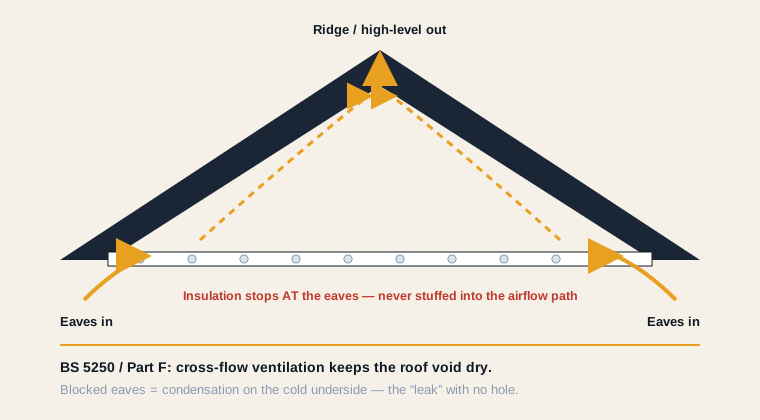
The two can also combine: a roof that lets water into a loft raises humidity, and poor roof-void ventilation then lets that moisture linger and condense. This is why a proper diagnosis looks at the covering, the flashings, the valleys and the eaves and ridge ventilation together. For a landlord, paying to repaint a mouldy ceiling without finding out which of these is at work is money wasted — the stain returns.
Damp and mould caused by a roof the landlord must repair falls under the landlord’s core duties: the Section 11 repairing obligation and the Homes (Fitness for Human Habitation) Act 2018, which requires the home to be fit to live in — and serious damp and mould can make it unfit. Local authorities can already act under the HHSRS, treating damp and mould as a health hazard and requiring the landlord to remedy it.
Awaab’s Law raises the bar further. In social housing, since 27 October 2025, landlords must investigate and address significant damp and mould within fixed timeframes. For private rentals the Renters’ Rights Act 2025 provides the mechanism to extend those duties, but it is not yet in force and the date is unconfirmed. The practical takeaway is unchanged whichever way the timetable falls: reported damp and mould needs a prompt, documented response, and where a roof is the cause, a prompt roof repair.
The English Housing Survey has found damp present in roughly one in ten private rented homes — and where a roof defect is the source, treating the mould without fixing the roof simply resets the clock until the next rain.
Source: English Housing Survey / Homes (Fitness for Human Habitation) Act 2018
We trace roof-related damp to its true source and fix it there, with the repair guaranteed 10 years in writing and documented for your records — not a stain painted over.
If a fault appears in covered work, we come back and put it right. No quibbling, no re-charge.
This guide is general information for Canterbury landlords, not legal advice. Housing law changes — check GOV.UK or take professional advice on your specific situation.
Yes — frequently. A failed roof covering, cracked flashing, blocked valley or leaking gutter lets water into the structure, and that persistent moisture is exactly what mould needs. Roof-related damp often shows as staining on upstairs ceilings or in the loft, sometimes far from where the water actually enters.
Where mould is caused by a roof defect the landlord must repair, then yes — it falls under the landlord’s repairing and fitness duties. Mould caused purely by a tenant’s lifestyle (drying washing indoors with no ventilation) is more complex, but a landlord still cannot ignore a home that is unfit, and must address inadequate ventilation.
Roof-related damp usually appears high up — ceiling stains, wet loft timbers, tide-marks near chimneys or valleys — and worsens after rain. Condensation tends to show on cold walls, in corners and around windows, and worsens in cold weather with poor ventilation. A survey can trace which you have; the fix is very different.
In social housing, Awaab’s Law (from 27 October 2025) sets fixed timeframes to investigate and fix significant damp and mould. For private landlords it is not yet in force — the Renters’ Rights Act 2025 provides the framework but the date is unconfirmed. Private landlords already owe duties under the Fitness Act and can face HHSRS enforcement for damp and mould now.
Promptly, and in writing. Even before Awaab’s Law reaches private rentals, leaving reported damp and mould unaddressed risks a fitness claim and council enforcement. The social-housing template — investigate significant damp and mould within about 10 working days — is a sensible standard to adopt now.
If the mould is driven by roof water ingress, fixing the roof removes the cause — but the existing mould and any wet materials still need treating and drying, and ventilation checking. We identify whether the roof is the source and fix it at root, rather than treating the stain and leaving the leak.
We find the true source and fix it at root, documented for your records. Call 0122 763 4920 or book a callback.
0122 763 4920