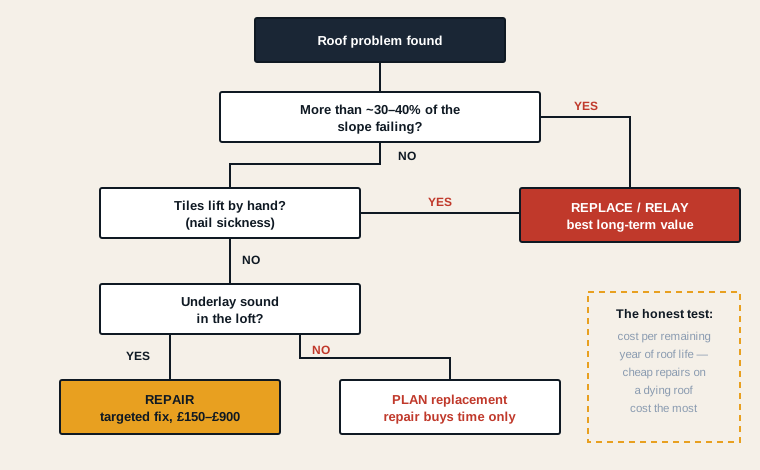
An honest decision framework for Canterbury homeowners — when a repair is the smart, cheaper fix, when it is money wasted, and when a re-roof is genuinely needed. No oversell, either way.
Tell us the job in 30 seconds. No pushy sales, no call-out fee.
📞 Call Now: 0122 763 4920Repair a Canterbury roof when the failure is localised and the rest is sound; replace when tiles are slipping across multiple slopes, leaks keep returning, or the covering has reached the end of its life. Once about a third of the roof has failed, repairing tile-by-tile costs more than a re-roof. A free survey gives you the honest answer. Call 0122 763 4920.
The repair-or-replace question comes down to three things: how much of the roof has failed, how old the covering and the underlay are, and what each option costs per remaining year of roof life. Get those straight and the answer is usually obvious.
Start with extent. If one area has failed — a slipped patch of tiles, a single leaking valley, a length of failed lead — and the rest of the roof is sound, repair it. A localised failure on an otherwise good roof is a repair job, full stop. But if tiles are slipping across several slopes at once, if leaks keep appearing in different places each winter, or if the felt underlay is shedding black grit into the loft, the whole covering is going and patching it just delays the inevitable at rising cost.
Then weigh cost-per-remaining-year. A £300 repair that buys five years costs £60 a year. A £7,000 re-roof that lasts fifty costs £140 a year but resets the clock completely and ends the leak calls. Where you are paying for repair after repair on a failing roof, those repairs are the expensive option, not the cheap one. The rule of thumb roofers use — once around a third of the covering has gone, stop repairing and re-roof — is really just this arithmetic in shorthand.
When a re-roof is oversell: if anyone recommends a full re-roof for a single slipped tile or one leaking valley on an otherwise sound roof, that is selling you work you do not need. A sound roof with one failed area needs a repair. We will tell you when that is the case, even though the repair is the smaller job.
Canterbury’s housing splits the decision cleanly by era. On the post-war and 1960s estates at Hales Place and Thanington, the common trigger is nail sickness: the galvanised fixing nails corrode and tiles let go across whole slopes at once. Once that starts on a concrete-tile estate roof, spot-repairs are a false economy and re-fixing or re-roofing the slope is the honest call.
On the Victorian terraces around St Dunstan’s and Wincheap, the tiles — often natural slate or clay peg — can have decades left while the leaks come entirely from failed lead at chimneys and valleys. Here a re-roof is usually oversell: the fix is leadwork, not a new covering. And on listed and conservation properties in the city core, a re-roof carries a consent requirement and a matched-material premium, which raises the bar for replacing rather than repairing.
The one thing that quietly forces re-roofs across all of these is the felt underlay. It has a design life of around thirty years, so a roof whose tiles still look fine can need stripping simply because the membrane beneath has perished. If your roof has never been stripped and is past thirty, that is worth knowing before you spend on another repair. A survey that lifts a few tiles to check the membrane and fixings tells you far more than any guess from the ground.
The complete new roof carries a 10-year workmanship guarantee, with 25–50 year manufacturer warranties on the tiles and membrane on top.
If a fault appears in covered work, we come back and put it right. No quibbling, no re-charge.
RICS building-survey guidance assesses a roof on the condition of its covering, fixings, underlay and structure together — not age alone — which is why a proper survey, rather than a rule of thumb, should drive the repair-or-replace decision.
Source: RICS home survey and building condition guidance
Not sure which way to go? A free survey gives you the honest answer — no oversell.
📅 Get My Free QuoteRepair if the failure is localised and the rest of the covering is sound — a few slipped tiles, one failed valley, a leaking flashing. Replace if tiles are slipping across multiple slopes, leaks keep appearing in new places, or the roof is at the end of its material life. A free survey settles it honestly.
A common rule of thumb: once roughly 30% or more of the covering has failed, repairing tile-by-tile costs more over a few years than a re-roof. Below that, targeted repair is usually the better value. It is a guide, not a law — condition matters more than any single number.
Concrete tile lasts 30–50 years, clay peg tile 60–100, natural slate 80–100+, and the felt underlay beneath any of them around 30. Many Canterbury re-roofs are triggered by the underlay failing even when the tiles look fine.
Yes, if the repair buys years at low cost and the rest of the roof is sound. No, if you are paying repeatedly for a roof whose underlay and fixings are failing everywhere — that money is better put toward a re-roof that lasts decades.
If a roofer recommends a full re-roof for a single slipped tile or one leaking valley, that is oversell. A sound roof with one failed area needs a repair. We will always tell you when a repair is the right, cheaper answer.
Age is a strong signal but not the whole story. A well-built 40-year-old roof may have years left; a poorly-laid 20-year-old one may not. We assess condition — fixings, underlay, timber and detailing — not just the date.
Insurance covers sudden storm or impact damage, not gradual wear. A roof that has simply reached the end of its life is a maintenance cost, not an insurance claim. Storm-damaged sections may be covered — we document those for you.
Free survey, fixed-price quote, no oversell either way. Call 0122 763 4920 or book a callback.
0122 763 4920