Specialist lead flashing, valley linings and lead roofing across Canterbury and East Kent. Correct code, proper dressing, lime mortar on period properties. Free surveys.
Failed lead is behind most leaks on Canterbury’s Victorian terraces and listed roofs. It shows as damp at a chimney, valley or bay, not in the open field of the roof.
When it is not the answer: If the leadwork is sound and only the pointing above it has failed, repointing is the fix — not new lead. Read the full guide.
We identify which lead has failed and the correct code to replace it.
Fixed price for the leadwork, dressed and fixed traditionally.
Booked once access is arranged.
Lead renewed in the correct code, dressed by hand to allow for movement.
Work shown to you and guaranteed weathertight.
| Job | Typical duration |
|---|---|
| Chimney flashing | Half to one day |
| Valley re-line | 1–2 days |
| Bay window top | Half a day |
| Soakers & abutment | 1 day |
Leadwork runs in most weather; only heavy rain during the actual dressing is paused.
Lead at chimneys and valleys usually needs scaffold or a tower for safe standing; bay tops are lower. Scaffold is specified for: chimney and valley leadwork at height - always itemised in your written quote, never a hidden extra, and we arrange it.
Canterbury’s medieval core and the Victorian terraces off Wincheap and St Dunstan’s often mean tight frontages, shared rear access and conservation-street constraints, so scaffold and skip placement take planning. Pavement scaffold and skip permits go through Canterbury City Council; allow a few working days on streets like Palace Street, Burgate, St Dunstan’s Street where space is tight.
Code 4, 5 & 6 lead · Correct dressing · Lime mortar on period stock
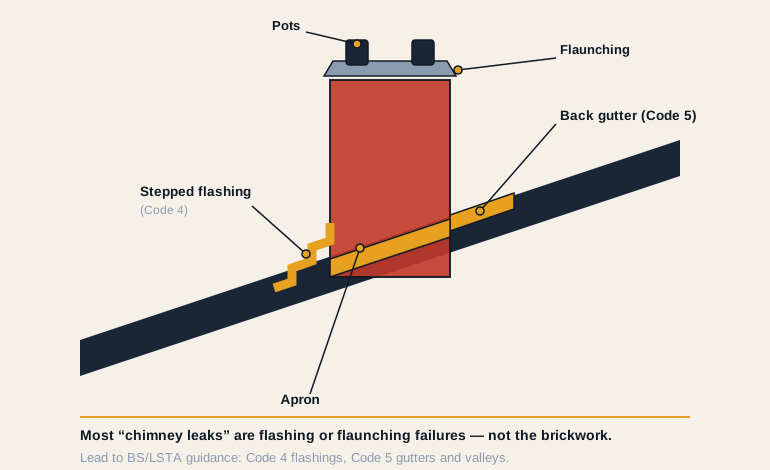
Canterbury has a higher concentration of Victorian and Edwardian terraced housing than most Kent towns, and that housing stock was almost universally built with hand-cut lead valleys, lead-soakered chimney stacks and lead-dressed abutment flashings. After 100–130 years, a significant proportion of this original lead work is either at or past end of life. The most common cause of interior water damage on Canterbury's period terraces is failed lead at the chimney or in the valley — not the tiles themselves.
Canterbury's Stour valley humidity accelerates lead surface oxidation marginally compared to drier inland sites, but the bigger issue is historical use of cement mortar to bed soakers. Cement is incompatible with lead's thermal expansion cycle. As temperatures change, the lead moves and the cement joint cracks. On Canterbury terraces with chimney stacks that get full sun on the south face and stay cold on the north, this differential movement is significant and causes early joint failure even on relatively recent lead installations.
Chimney flashing and soaker replacement (front apron, back gutter, step and cover flashings), valley lining in cut-to-width lead, parapet gutter linings, dormer cheek and roof flashings, abutment step flashings to party walls and extensions, and lead flat roof sections on bay window tops and Victorian extensions. All work to Code 4 minimum, Code 5 or 6 where conditions require.
“Lead valley on our 1890s terrace in Wincheap had been patched three times by previous roofers. Canterbury Roofing stripped it back, laid a proper Code 5 valley lining, dressed it correctly. No leaks since.”
“Chimney flashing had been deteriorating for years — could see the gaps where the cement had cracked away. Proper lead replacement with lime mortar pointing. Done in a day and no more leaks into the breast.”
“Step flashing along the party wall had failed on our Victorian end-of-terrace. Canterbury Roofing ripped out the old bodged lead and fitted a proper Code 4 stepped system. Totally watertight.”
| Job | Typical range | Notes |
|---|---|---|
| Chimney flashing | £250–£600 | Correct code |
| Valley re-line | £400–£900 | Both slopes lifted |
| Bay window top | £300–£700 | Hand-dressed |
| Soakers & abutment | £250–£600 | Interleaved |
| Whole-stack leadwork | £600–£1,200 | Listed stock |
Worked example: Renewing failed flashing and a bay top on a St Dunstan’s terrace: about £750.
No deposit under £500. Itemised VAT invoice on completion.
Covering CT1, CT2, CT3, CT4 and surrounding postcodes.
Leadwork is guaranteed 10 years; correctly sized and dressed lead lasts decades, which is why we never under-gauge it.
If a fault appears in covered work, we come back and put it right. No quibbling, no re-charge.
Confined, tidy work at one junction of the roof — minimal mess, external only. You do not need to stay home for external work - we just need power and access agreed in advance.
Leadwork is largely weather-tolerant, which is why it is a reliable year-round repair. The Stour valley holds humidity, so drying times lengthen in autumn and moss returns fast on north-facing and tree-shaded roofs.
Lead flashing replacement around a standard chimney stack in Canterbury typically costs £280–£550 depending on the number of abutments and the lead code required. Step flashing along a dormer or extension wall abutment runs £180–£400 per run. Valley linings in lead cost £350–£700 depending on length. All lead work includes a free survey and fixed-price quotation.
Code 4 lead (1.8mm) is the minimum for flashings on Canterbury properties. For chimney back gutters, parapet gutters and valley linings we specify Code 5 or Code 6, which are thicker and more durable in Canterbury's wet valley conditions. The original lead on many Victorian Canterbury properties was Code 3 — significantly thinner than current standards — and has typically reached end of life after 80–100 years of service.
The combination of Canterbury's above-average rainfall, the Stour valley humidity, and the legacy use of cement mortar to bed original lead soakers is the primary cause. Cement mortar is incompatible with lead's thermal movement — the joint cracks as the lead expands and contracts, allowing water infiltration behind the flashing. We always use lead clips and lime mortar pointing on Canterbury period properties, which allows correct movement without joint failure.
Yes. Lead valley replacement is standard maintenance on Canterbury's Victorian and Edwardian stock and does not typically require planning consent. We are experienced in installing cut-to-width valley linings with correctly dressed rolls and soakers, matching the original specification. On some listed buildings a specific lead code may be required — we check and advise as part of the free survey.
Correctly specified and installed lead flashings and valley linings should last 50–80 years in Canterbury conditions. The key variables are lead code (thickness), correct dressing technique, and the use of appropriate fixing clips rather than mortar embedding. Our lead work is covered by our 10-year workmanship guarantee.
Yes — we cover the surrounding towns and villages across East Kent:
No call-out fees. No obligation. An honest quote from a local Canterbury roofer who turns up when they say they will.
0122 763 4920 Email Us InsteadOn a listed or conservation property? See heritage roofing for traditional leadwork.