Expert chimney repointing in lime mortar across Canterbury and East Kent. Period property specialists — correct mortar for the building. Stop damp at source. Free surveys.
Chimney trouble shows as damp on the chimney breast, crumbling mortar, or a leaning stack. On Canterbury’s period roofs it is usually the flashing or the pointing.
When it is not the answer: A sound stack with only tired pointing needs repointing, not a rebuild — we never oversell a rebuild you do not need. Read the full guide.
We inspect the stack, flashing, pointing and flaunching from close up.
Fixed price for the specific work — flashing, repointing, flaunching or rebuild.
Booked in once scaffold or tower access is arranged.
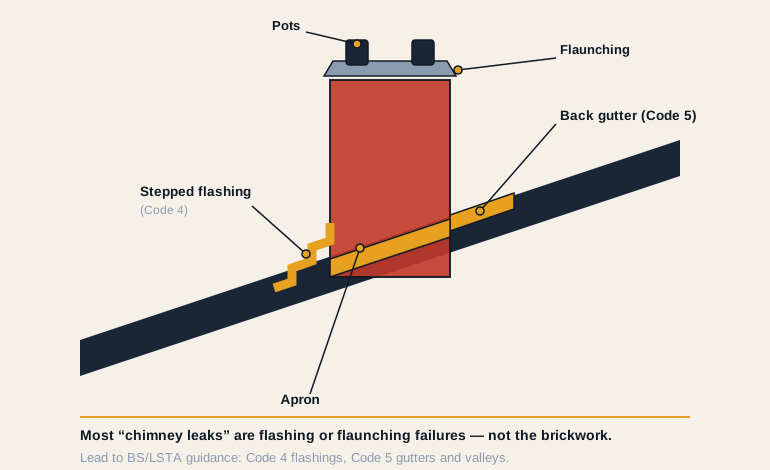
Lead renewed in the correct code, pointing and flaunching in the right mortar for the stock.
Site cleared and the work guaranteed weathertight.
| Job | Typical duration |
|---|---|
| Flashing renewal | Half to one day |
| Repointing a stack | 1 day |
| Flaunching & pot re-bed | Half a day |
| Full stack rebuild | 2–3 days |
Mortar work needs dry, frost-free conditions; we schedule pointing and flaunching accordingly.
Chimney work almost always needs scaffold or a tower for safe standing at the stack; it is itemised in the quote. Scaffold is specified for: most stack work — flashing, repointing, flaunching and rebuilds - always itemised in your written quote, never a hidden extra, and we arrange it.
Canterbury’s medieval core and the Victorian terraces off Wincheap and St Dunstan’s often mean tight frontages, shared rear access and conservation-street constraints, so scaffold and skip placement take planning. Pavement scaffold and skip permits go through Canterbury City Council; allow a few working days on streets like Palace Street, Burgate, St Dunstan’s Street where space is tight.
Lime mortar on all period stock · Scaffold included · 10-year guarantee
Canterbury's high concentration of Victorian and Edwardian terraced housing means chimney repointing is one of our most frequently requested services. The typical Canterbury period terrace has two to three chimney stacks — front and rear on the main ridge — and both are exposed to the above-average rainfall and humidity of the Stour valley. The original lime mortar on these stacks has in many cases already been repaired at some point in the 20th century, often in cement, which accelerates the brickwork deterioration that leads to damp ingress.
The consequences of eroded chimney pointing in Canterbury are predictable: water penetrates the stack and tracks down the chimney breast, appearing as a damp patch on the breast wall in an upstairs room, or as a damp ceiling at the top of the staircase. This is one of the most common interior damp complaints across Canterbury's period terraces. The repair is almost always a combination of correct repointing and lead flashing replacement — rarely just one or the other — and we survey both on every visit.
The soft-fired bricks used in Canterbury's Victorian and Edwardian construction are not compatible with modern cement mortar, which is significantly harder than the brick itself. When cement is used, it traps moisture in the brick face, causing the brick to spall and erode faster than the mortar. We use NHL 3.5 or NHL 5 hydraulic lime mixed with sharp sand on all pre-1919 Canterbury repointing, matched to the original profile. This is the only specification that will not accelerate the brickwork deterioration it is meant to prevent.
“Three chimney stacks on our Victorian terrace in Hales Place had eroded pointing letting in damp. All repointed in lime mortar to the correct profile. No more leak into the chimney breast.”
“Previous contractor had cement-repointed our Victorian chimney. Canterbury Roofing cut out the cement, restored lime mortar throughout. Understood exactly why this matters for the brickwork.”
“Repointing and new lead flashing on an elevated Harbledown chimney. Scaffolding included in price. Professional team, quality finish.”
| Job | Typical range | Notes |
|---|---|---|
| Flashing renewal | £300–£600 | Correct lead code |
| Repointing a stack | £150–£800 | By stack size |
| Flaunching & pot re-bed | £150–£400 | Per stack |
| Cowl / capping | £80–£200 | Fitted |
| Full stack rebuild | £800–£2,500+ | Matched brick & lime |
Worked example: Repointing and re-flaunching a Victorian stack in St Dunstan’s with a tower: about £650.
No deposit under £500. Staged payment on rebuilds, materials on site first. Itemised VAT invoice.
Covering CT1, CT2, CT3, CT4 and surrounding postcodes.
Chimney workmanship is guaranteed 10 years; on listed and conservation stacks we point in lime as required.
If a fault appears in covered work, we come back and put it right. No quibbling, no re-charge.
Scaffold at the stack for a day or two and some mortar debris — sheeted and cleared before we leave. You do not need to stay home for external work - we just need power and access agreed in advance.
Lime and cement mortar need dry, above-freezing weather to cure, so stack work is weather-led. The Stour valley holds humidity, so drying times lengthen in autumn and moss returns fast on north-facing and tree-shaded roofs.
Chimney stack repointing on a standard Canterbury 3-bed property typically costs £200–£600 depending on chimney size, condition and access. Properties with multiple stacks or where severe mortar erosion has reached the brickwork face may be at the higher end. All repointing on pre-1919 Canterbury properties is carried out in lime mortar as standard — an important requirement that distinguishes our work from contractors who use cement on period stock.
Canterbury's above-average rainfall combined with the Stour valley's winter humidity means mortar joints on exposed chimney stacks erode faster than in drier locations. North-facing stacks and those on elevated Harbledown properties are particularly vulnerable. Once the mortar joint erodes to a depth of more than 6mm, water penetrates behind the stack coping and flashing, causing the leak-into-breast failure that is one of the most common interior damp problems on Canterbury's Victorian and Edwardian terraces.
All pre-1919 Canterbury properties — Victorian, Edwardian and earlier — require lime mortar for chimney repointing. The original brickwork on these properties was built in lime and the bricks are soft-fired. Cement mortar is too hard and traps moisture in the brick face, causing accelerated spalling. A typical lime mix for Canterbury chimney repointing is NHL 3.5 or NHL 5 hydraulic lime with sharp sand. We match the original mortar profile on all repointing work.
Typically yes for a safe and quality result. Chimney stack repointing at ridge height requires scaffold access to work safely and to achieve proper joint depth and profile. Some accessible lower stacks can be reached from a tower or ladder system, which we assess on the free survey. We always specify the safest and most cost-effective access method and include scaffolding costs in the quotation.
Correctly carried out lime mortar repointing on a Canterbury period property should last 25–40 years. Poorly specified cement repointing on the same stack may fail within 5–10 years as the cement traps moisture and the joints crack. Our repointing is covered by our 10-year workmanship guarantee.
No call-out fees. No obligation. An honest quote from a local Canterbury roofer who turns up when they say they will.
0122 763 4920 Email Us InsteadOn a period or listed property? See heritage roofing for lime mortar and conservation-compliant work.