Cold loft and warm roof insulation installation across Canterbury and East Kent. Correct specification for Canterbury's period housing stock. No spray foam. Free surveys.
A failing flat roof is usually ageing felt that has cracked, blistered or split at a seam or upstand. Here is how to tell whether yours needs a patch or a recover.
When it is not the answer: If a modern GRP or EPDM roof has a single localised puncture, a patch is enough — you do not need a full recover. Read the full guide.
We locate the failure and check the deck and the falls beneath the covering.
Fixed price for patch or full recover in GRP or EPDM, deck repair included if needed.
Most flat roofs are recovered in one visit; larger areas booked in.
Old covering off, deck repaired, new system laid with proper falls to the outlet.
Site cleared and the roof guaranteed.
| Job | Typical duration |
|---|---|
| Garage / small outbuilding | 1 day |
| Single-storey extension | 1–2 days |
| Dormer flat roof | 1 day |
| Large wrap-around extension | 2–3 days |
GRP needs a dry spell to cure; we schedule around the forecast and never lay onto a wet deck.
Most flat roofs are low and reached from a tower; scaffold only where the flat roof is at height or wraps a two-storey return. Scaffold is specified for: first-floor or wrap-around flat roofs, or where edge protection is needed - always itemised in your written quote, never a hidden extra, and we arrange it.
Canterbury’s medieval core and the Victorian terraces off Wincheap and St Dunstan’s often mean tight frontages, shared rear access and conservation-street constraints, so scaffold and skip placement take planning. Pavement scaffold and skip permits go through Canterbury City Council; allow a few working days on streets like Palace Street, Burgate, St Dunstan’s Street where space is tight.
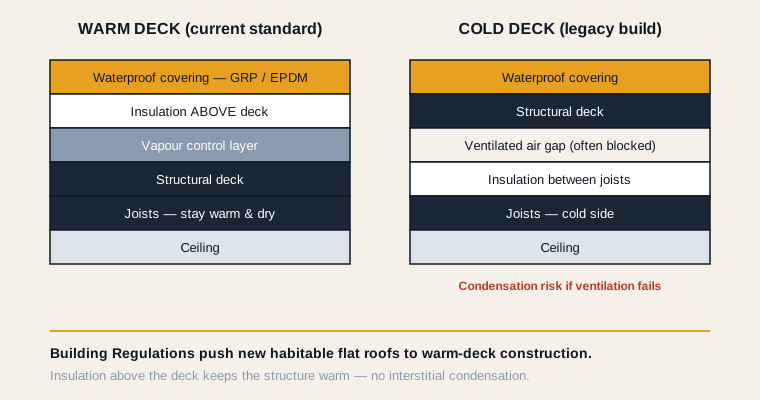
Cold loft · Warm roof · No spray foam · Ventilation maintained
Canterbury's Victorian and Edwardian housing stock — the terraces of Wincheap, St Dunstan's, Hales Place and the Old Dover Road corridor — was built with minimal or no roof insulation. A typical Canterbury Victorian terrace loses 25–30% of its total heat through the uninsulated roof void, contributing both to high energy bills and to the condensation problems that affect the top floors of many period Canterbury homes in winter. Correctly installed cold loft insulation is the single most cost-effective energy efficiency improvement available to most Canterbury homeowners.
Canterbury's above-average Stour valley humidity means ventilation management is more critical here than in drier locations. We always assess the existing ventilation provision before installing any insulation and maintain the correct 50mm ventilation gap above the insulation layer. On Victorian properties with minimal eaves ventilation, we install additional eaves vent strips as part of the installation to ensure the roof void stays dry. This is a step that is routinely skipped by lower-quality installers and is a common cause of the post-insulation damp problems seen on period Canterbury terraces.
We remove existing spray foam insulation from Canterbury properties where it is causing mortgage valuation or sale issues. Spray foam is removed manually to avoid damaging the roof timbers, ventilation is reinstated, and the void is re-insulated with mineral wool to current specification. We handle the full process and provide a written post-installation report.
“Victorian terrace in Wincheap had virtually no loft insulation. Cold loft installation completed in a day. The difference in the top floor temperature that first winter was immediately obvious.”
“Loft insulation upgraded as part of our re-roof. Canterbury Roofing combined both jobs efficiently. Good value and properly done — the ventilation gap was maintained throughout.”
“Previous owners had spray foam installed. Canterbury Roofing removed it, reinstated timber ventilation and installed correct mineral wool. Straightforward process, mortgage issue resolved.”
| Job | Typical range | Notes |
|---|---|---|
| Garage / outbuilding | £1,200–£2,000 | EPDM or GRP |
| Single-storey extension | £2,000–£4,000 | GRP for complex shapes |
| Large / wrap-around | £3,000–£6,000 | GRP seamless |
| Dormer flat roof | £800–£2,000 | Incl. lead junctions |
| Felt strip & deck repair | from £300 | Added if deck wet |
Worked example: A 12m² rear kitchen extension off Wincheap recovered in GRP with a soft-deck patch: about £2,600.
No deposit on small flat-roof repairs. Staged payment on larger recovers, materials on site first.
Covering CT1, CT2, CT3, CT4 and surrounding postcodes.
GRP and EPDM systems carry a 10-year workmanship guarantee and 20–35 year material life — far beyond the felt we replace.
If a fault appears in covered work, we come back and put it right. No quibbling, no re-charge.
Quiet, quick work confined to the flat area — minimal mess and usually done in a day. You do not need to stay home for external work - we just need power and access agreed in advance.
EPDM can go on in most conditions; GRP needs dry, so we watch the forecast. The Stour valley holds humidity, so drying times lengthen in autumn and moss returns fast on north-facing and tree-shaded roofs.
Cold loft (between joist) insulation for a standard Canterbury terraced or semi-detached property typically costs £300–£700 installed. Warm loft (between and over rafter) spray foam or rigid board insulation for conversion-ready lofts runs £1,500–£4,000 depending on area. Government grant schemes may be available for eligible Canterbury households — we advise on current eligibility as part of the free survey.
Cold loft mineral wool insulation (between joists + across joists in two layers, to 270mm total) is the standard and most cost-effective recommendation for Canterbury's Victorian and Edwardian terraced housing. It eliminates the most significant heat loss path on these properties and is compatible with the original roof construction. Spray foam insulation is not recommended on Victorian properties as it can damage original rafter timbers and causes issues with mortgage valuations.
Correctly installed cold loft insulation with adequate ventilation will not cause condensation. Problems arise when insulation is installed without maintaining the ventilation gap above the insulation layer, or when roof vents are blocked. Canterbury's above-average humidity makes correct ventilation more important here than in drier locations. We survey the ventilation position before installing insulation and address any existing deficiencies.
Yes. Spray foam insulation in the roof void makes mortgage valuations problematic because it restricts access to inspect roof timbers and in some cases bonds to the timbers causing issues on removal. Several UK mortgage lenders refuse to lend on properties with spray foam insulation installed. We do not install spray foam in Canterbury properties and will advise on removal of existing spray foam installations if asked.
Yes, and the combination is the most cost-effective approach. When scaffolding is already in place for a re-roof, upgrading loft insulation at the same time avoids a second mobilisation cost. We include an insulation assessment in all re-roof surveys and price the combination where relevant.
No call-out fees. No obligation. An honest quote from a local Canterbury roofer who turns up when they say they will.
0122 763 4920 Email Us Instead